When the Art World Went Quiet and Why It’s Time to Speak
When the Art World Went Quiet and Why It’s Time to Speak

(Photos and writing by Harrison Love)
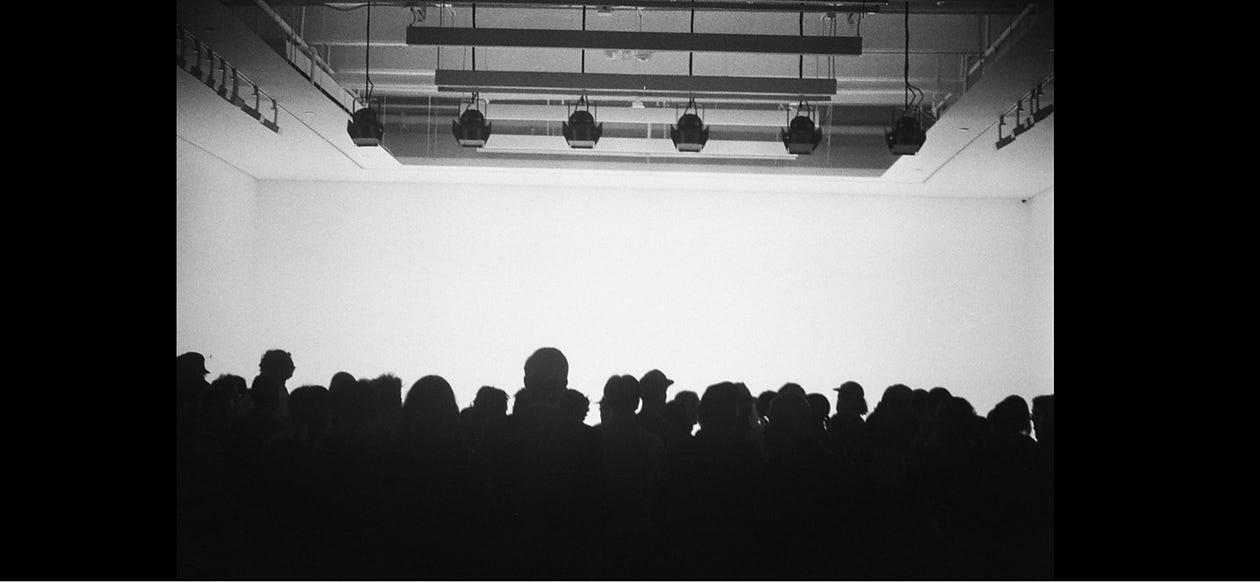
Since early 2025, I have been working on a black-and-white 35mm photo series, an unfiltered gaze into the tense and often dissonant atmosphere of the contemporary art world. Shot across the five boroughs of New York, these images don’t focus on the art itself, but on the people surrounding it. The crowds drifting silently through galleries, lost in thought or perhaps in disponendcy.
“You have to be a product that’s being bought and sold and consumed, and you have to perceive yourself that way in order to function.” — Mitski

What my camera witnessed were not conversations about ideas, politics, or purpose but instead, a subdued quiet. Rooms filled with intellectuals and creatives, seemingly numbed. Decorative work hung in sterilized, mercantile environments, hermetically sealed spaces that felt more like showrooms than sites of human creation. And amidst it all, throngs of overthinkers, quietly seeking meaning, yet often leaving unsatisfied.
“I think forming gangs, mafias, collectives, networks, bands of people is a way to survive in the hostile capitalist system and then eventually a way to become a pressure group, in order to transform these particular conditions.” — Claire Fontaine

Now, as we begin to witness the slow dismantling of the traditional art world and with it, the reformation of our systems of art and commerce; there is a quiet reckoning underway. Artists are rethinking their responsibilities to the public, to each other, and to the future. We are questioning how we can meaningfully engage with structures that were never truly built to inspire, educate, or entice. These are systems that have too often denied the artist’s identity in favor of commodification.

These atmospheres, these spaces of “deadpan” display, have not evolved meaningfully in my lifetime. And yet, a new urgency is emerging. We are being asked, perhaps even called, to imagine something better. To design new modes of exchange, new rituals of experience, and new ways to remind each other that art was never meant to be quiet, or sterile, or safe.
“It’s a cyclical thing that is not changing. It’s like we’re crabs: if one or two of us gets out of the bucket… we should be protesting! We should be pissed that only one or two made it out.” — Mickalene Thomas

My answer to this call to action has been my creation of STOA which you can find on Instagram @stoa.bk which endeavors to bring Art to the people rather than expect them to comfortably come to spaces like the ones documented which often charge the artist high submission and hanging fees, as well as take 50% commission from the artist and act as barriers between the art artists, and their patrons nullifying any ability for the artist to be able to create lasting relationships and denying the patrons any chance at meeting or meaningfully interacting with the art or artist.
Many institutions “are yet to come to terms with a way of showing art without making it appeal only to the elite, thereby losing its true meaning.” — Ibiyinka Alao

What I have documented is not an isolated phenomenon. Across the world’s cultural capitals from London to Hong Kong, Berlin to São Paulo, similar atmospheres take shape. The muted rooms, the decorous silence, the air of disconnection are symptoms of a deeper structural malaise within the contemporary art economy. This is not simply about taste, or curatorial choice, but about the way art is being made, shown, and sold in the early twenty-first century.

The market has, in many ways, consolidated into a system dominated by mega-galleries and corporate-backed fairs, where scale and brand recognition often eclipse experimentation. The smaller, independent gallery,once a fertile ground for discovery, is steadily vanishing under the pressure of astronomical rents and the gravitational pull of a collector base increasingly focused on safe, “blue-chip” investments. The result is a narrowing of opportunity: a shrinking middle class of working artists, wedged between a handful of global stars and a vast pool of creatives struggling for visibility.

Collectors themselves have shifted. The mid-tier buyer — the one who purchases from genuine connection or curiosity — has been eclipsed by speculators who view art as an asset class. Art fairs have become the central sales moments, their Instagram-ready booths tailored more to fast attention than to slow contemplation. The work that thrives in such environments is often that which photographs well, fits neatly into a portfolio, and offers immediate, uncomplicated gratification. In these conditions, intellectual rigor can become a liability rather than a virtue.

For artists, the barriers to entry have never been higher. Pay-to-play submission models, steep hanging fees, and commissions that routinely climb to 50% create a precarious environment. Even success within the gallery system can mean disconnection: the gallery often becomes the sole interface with the collector, severing the possibility of a lasting personal relationship between artist and patron. The result is an art world where the transaction eclipses the encounter, and where the aura of the work is diminished by the sterility of its presentation.
This isn’t simply an economic issue — it is a cultural one. When art is stripped of intimacy, when the spaces in which we experience it feel more like luxury showrooms than laboratories of human expression, we lose the sense of art as a living, breathing exchange. The audience becomes passive. The artist becomes a supplier. The shared imaginative space between the two collapses.

My answer to this quiet crisis has been the creation of STOA — a platform dedicated to reversing this dynamic. STOA brings art directly to people, embedding exhibitions into environments where engagement is natural, unmediated, and alive. It refuses the economic gatekeeping of traditional spaces, eliminating submission fees and exorbitant commissions. It treats the meeting between artist and audience as the primary event, not a byproduct. It is an experiment in reimagining the art encounter as an act of community rather than commerce.

We are standing at a threshold. The dismantling of the old order is not just a loss; it is an opening. This is the moment to design new modes of exchange, to invent new rituals of showing and seeing, to create platforms that value presence over product. Art was never meant to be quiet, or sterile, or safe. If we can resist the urge to replicate the old systems in new clothes, we can return to something more vital — art that risks, provokes, and connects in ways that are deeply, unmistakably human.


Here’s an expanded look at the market data from global art market trends from the past 20 years:


What we see here are the larger global markets ramping to extreme profits and auction sales.
2000 — 2017: Chart showing growth of global art-market value with segmentation by auction, dealer, and other channels .
2009 — 2024: A timeline correlating total global art sales, illustrating how values recovered from the 2008 crisis, peaked mid-2010s, and recently softened amid broader economic shifts.
2017 — 2024: Annual data points — $63.7B (2017), ~$65B (2023), ~$57.5B (2024) — highlighting market fluctuations.
But this doesn’t fit the trends from the past several years. Here is a look at trends from the past several years:


What we see here is the market shrinking in growth quite dramatically.
Auction sales: 2023 vs 2024 — shows a decline from ~$14.0bn (2023) to $10.2bn (2024), using Artnet’s reported 2024 auction total and the reported YoY drop.
Global art-market sales: 2023 vs 2024 — shows total market sales declining to $57.5bn in 2024 (≈12% YoY decline). This visual is drawn from Art Basel & UBS / FT summaries.
Note:
The art market is heterogeneous: the high-end auction sector, galleries, fairs, online marketplaces, and local/regional dealers behave differently. These charts are designed to illustrate broad trends described in your article, not to replace full econometric analysis.
Bibliography:
1. Mitski. Interview excerpt in New University, “We Need to Recognize the Commodification of Artists,” by Megan Tagami. February 9, 2022. Accessed August 9, 2025. https://newuniversity.org/2022/02/09/we-need-to-recognize-the-commodification-of-artists/
2. Claire Fontaine. Artist biography and interview excerpts. Wikipedia, “Claire Fontaine.” Accessed August 9, 2025. https://en.wikipedia.org/wiki/Claire_Fontaine
3. Mickalene Thomas. Interview in Artnet News, “Pull Quotes: Women’s Place in the Art World.” September 30, 2019. Accessed August 9, 2025. https://news.artnet.com/womens-place-in-the-art-world/pull-quotes-womens-place-art-world-1655308
4. Ibiyinka Alao. Artist biography and statements. Wikipedia, “Ibiyinka Alao.” Accessed August 9, 2025. https://en.wikipedia.org/wiki/Ibiyinka_Alao
Harrison Love is Artist and Author of “The Hidden Way,” an award winning illustrated novel inspired by first hand interviews about Amazonian Myths and Folklore. He is also the Founder of the Permaculture Art Gallery STOA. More information about his Art and Writing can be found on www.harrisonlove.com


Comments
Post a Comment