Hunted in the Open: An Artist’s Journey of Thriving Under Digital Siege
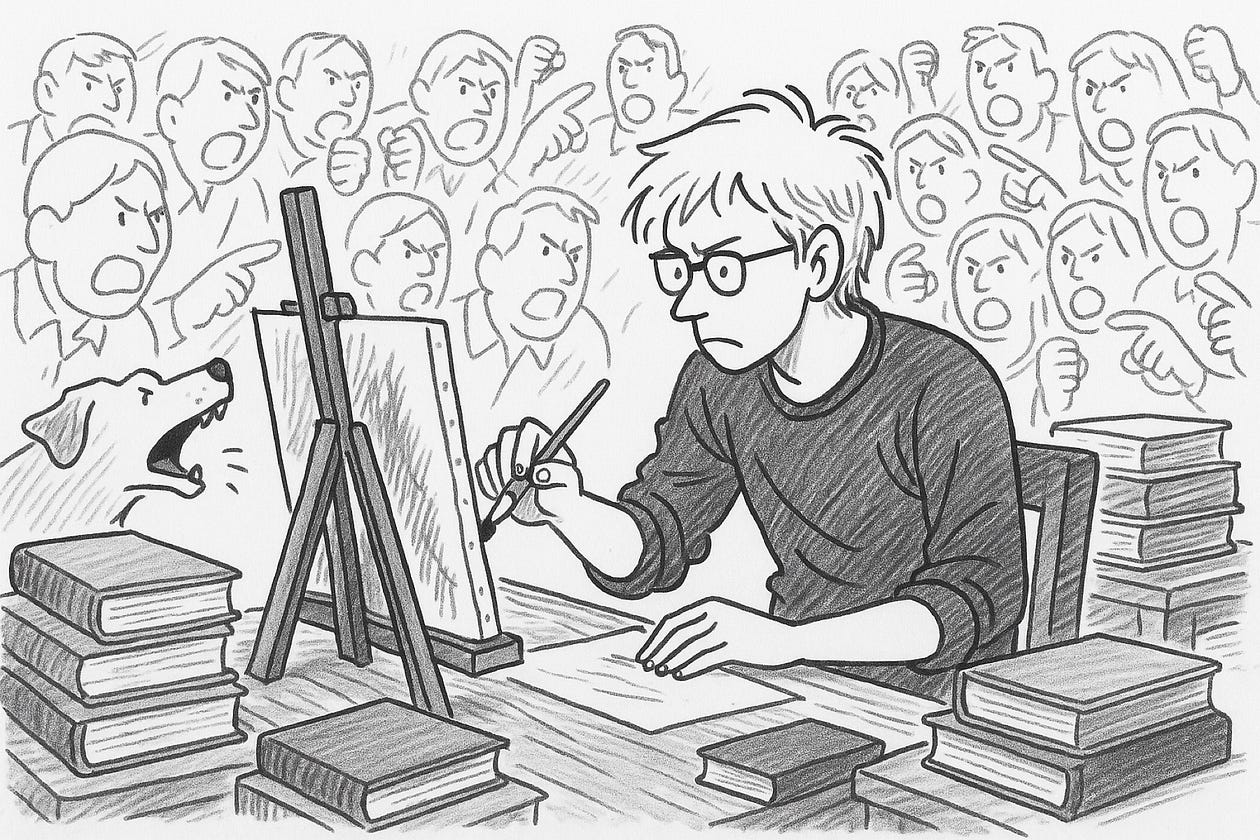
Hunted in the Open: An Artist’s Journey of Thriving Under Digital Siege

“The closer you are to visibility, the more likely you are to become a target.” — Legacy Russell, Glitch Feminism: A Manifesto (1)
In the modern age, the line between the artist and the audience has dissolved. Once, artists created in solitude and emerged on occasion to share their work. Now, we are expected to share everything; our thoughts, our progress, our process, our presence. To exist as an artist in the 21st century is to participate in an ever-streaming dialogue with a digital public. For some, that proximity to audience builds community. For others, it becomes a weapon.
I speak from experience. For the past several years, I’ve lived a life both connected and surveilled. While attempting to share my artwork, my philosophy, and my story, I became the target of persistent, obsessive stalkers. Two individuals in particular crossed every conceivable line, not only harassing me online but creating unauthorized products out of my artwork, impersonating me, infiltrating my social circles, and doxxing me on multiple platforms.
Despite blocking them, they maneuvered around every safety mechanism the social media companies claim to uphold. They’ve harassed venues where I’ve exhibited, weaponized Reddit threads and anonymous forums like 4chan, and aligned themselves with a broader alt-right online subculture known for organizing mob-style attacks. Names like Sam Hyde become rallying cries for their distorted sense of humor and cruelty. The resulting spam, trolling, and targeted campaigns have been relentless.
This isn’t just trolling. And it’s not just bullying either, though that would be bad enough, bullying is already one of the more cowardly and grotesque traits in human behavior. But this is something else entirely. This is an organized erasure of boundaries, a full-scale impersonation campaign meant not just to hurt me, but to confuse the public, to poison the well. The goal isn’t just to harass, it’s to collapse the possibility of trust itself. That is the real toll. I have always tried to approach the outside world with openness, with a sense of generosity, with art and writing offered as bridges. But when that openness becomes weaponized against you, when your words, your name, your presence can be turned inside out and handed back to the world as something vile, you begin to doubt whether those bridges ever led anywhere safe.
Because if truth no longer matters, if what seems true holds more power than what is true, then we’ve arrived at a dangerous place. That is the real sickness of this time. It isn’t just misinformation or digital hostility, it’s a cultural moment in which the truth is no longer precious. And for an artist, this is devastating. So much of legacy depends on interpretation, and if interpretation is ruled by fear, algorithms, and distortion, then legacy can be dismantled before it even forms. One anonymous user can rewrite your entire character in the eyes of thousands with a single thread or lie. And in that climate, what chance does sincerity have?
Art, if it is great, lives in the world as an open question. It requires a certain amount of faith from the viewer or reader, a willingness to meet the work halfway. But when the time we live in is full of suspicion, division, and ugliness, then even the most altruistic offering can be twisted. You can write something honest, vulnerable, and full of care and someone will find a way to turn it into ammunition. You can paint something beautiful, and it can be used as a mask for cruelty. This is the unbearable contradiction: the more open-hearted the work, the easier it is to exploit. And yet, I keep creating, even knowing this. Because despite the distortion, despite the danger, I still believe in the original impulse: to connect, to express, to make something meaningful in the face of noise.
A Pattern of Destruction: Pluralizing the Victims
What makes this situation more terrifying is that I am not their only target.
These individuals have made a habit of impersonating me online to wreak havoc on others. They have reached out to vulnerable individuals, artists, activists, LGBTQ+ community members, and women with threatening messages, false identities, and explicit content, all under my name or likeness. Their intention is not only to torment me, but to destroy the reputations and psychological safety of others by proxy.
This campaign of impersonation has had devastating consequences. I’ve received emails from terrified strangers in small towns, confused businesses, and even community centers trying to make sense of aggressive, disturbing messages they believed came from me. I’ve had to issue cease-and-desist letters not to protect my intellectual property but to protect my name from being associated with harm.
What started as a personal attack evolved into a larger network of chaos, a digital wildfire touching innocent people, institutions, and communities who simply happened to be within the blast radius. The stalkers’ reach has extended far beyond me, pluralizing their victims and leaving emotional wreckage in their wake.
“The digital world promised a voice for everyone, but it often amplifies the loudest threats instead.” — Seyi Akiwowo, digital activist and founder of Glitch UK (2)
I’ve personally chosen to take the high road. That decision hasn’t been easy. Over the course of four years, I’ve received hundreds of harassing texts, phone calls, voicemails, emails, and anonymous comments from catfish profiles. These attacks haven’t just come at night or in moments of weakness; they’ve been relentless, invasive, and deeply personal. And yet, I’ve refused to debase myself by becoming like those who’ve hunted me. I’ve not retaliated. I’ve not slandered or stooped to their level. Instead, I’ve documented everything. I’ve created police reports, saved records, and followed legal protocol with exhausting precision. That diligence hasn’t yet brought justice but it has preserved my integrity.
Unfortunately, the systems that are supposed to protect people like me and the other victims involved have proven deeply flawed, if not entirely ineffective. Multiple reports have been filed. Multiple detectives have been assigned. And still, the gears of justice grind slowly… too slowly. For myself and the other victims, I can only hope that we never have to endure anything like this again. By writing this and making it public, I want to give all of us something concrete: a single, visible account we can point to. Something to show to friends, to family, to colleagues and community members. So we no longer have to spend hours explaining what has been happening, we can simply point and say — This. This is what we’ve been living through. This is how wrong it is.
One would think that people have better things to do with their lives than spend years attacking strangers. You’d think at some point they’d move on. But their persistence reveals more about their pathology than it does about anything else. There’s a tragic emptiness behind these acts; a failure of empathy, a disconnection from purpose, a life so misaligned that harming others becomes its only throughline. Whatever relationships they do have (if any ) are likely built on deception, manipulation, or complete compartmentalization. They live in shadow, practicing cruelty in secret. But what they don’t realize is that this behavior is not just morally bankrupt; it’s criminal. And the longer they continue, the closer they edge to exposure, to accountability, and to the collapse of the illusion they’ve tried so hard to maintain.
Law Enforcement in Fragments
Currently, six police precincts across the United States are investigating this coordinated harassment. Detectives in different states have opened individual cases, each tracking a different thread of the same tangled web. A number of reports involve impersonation, harassment, cyberstalking, and even extortion.
And yet, justice moves slowly. Each local jurisdiction sees only part of the puzzle, unable to grasp the full scale of the coordinated digital attack. This is where federal attention becomes critical.
There is now an open FBI investigation into the proliferation of revenge pornography tied to these same perpetrators. Images and content are being weaponized to shame, humiliate, and provoke. The internet has given these individuals a megaphone with no oversight, and they use it with surgical cruelty. What they are doing is not just trolling, it is criminal. It is domestic terrorism carried out through screens.
The delay in cohesive legal response speaks volumes about how underprepared our systems are for the new terrain of digital violence. Artists and public figures especially those who stand for equity, empathy, and free expression are often the first casualties in a battlefield where identity, creativity, and voice are weaponized against us.
“Online abuse is a form of censorship — its goal is to make people disappear.” — Zainab Ahmed, digital rights researcher (3)
Adapting Through Multiplicity
To protect myself, I have pluralized. My public identity is now layered with pseudonyms, alternate names under which I can publish, show work, or experiment freely without immediate association. This fracturing isn’t fragmentation; it’s a survival strategy. Each name holds a different frequency, allowing me to engage with the world while maintaining boundaries, both psychological and practical.
I’ve also had to think differently about how to share art. I’ve hosted pop-up experiences without disclosing my identity. I’ve experimented with anonymous exhibitions, private showings, and invite-only spaces, ephemeral offerings that resist the click-and-consume culture of online art visibility. I’ve withdrawn from some platforms entirely, rethinking the cost of exposure and choosing instead to invest in slowness, privacy, and intimacy with those who truly value the work.
This is not a story of defeat. It is one of resistance and resilience.
“The internet does not forget. It becomes the most powerful tool in the stalker’s toolkit.” — Danielle Citron, legal scholar and author of Hate Crimes in Cyberspace (4)
The artists of our time are not just creators, we are navigators of a fraught, hyper-visible reality where anonymity and fame blur, and where our labor is so easily co-opted, commodified, or attacked. And yet, through this, I’ve found a sharper purpose.
The very threats that sought to silence me forced me to sharpen my tools: to build new systems, encrypt my freedom, and reclaim authorship in unorthodox ways. This is the artist’s role, after all not just to reflect the world, but to adapt and reshape it.
On Freedom and Moving Forward
“Hurt people hurt communities. The digital age has allowed one person’s pathology to scale across thousands of lives.”- Adrienne Maree Brown (5)
I still believe in the power of sharing. I still want to connect, to create, to inspire. But I now do so with the understanding that the boundary between creator and consumer must be redefined. We must build ecosystems that protect artists mentally, physically, and spiritually. This includes pressuring platforms to enact real safety protocols, but also imagining new ways of being in public, of showing up without being consumed.
I share this not as a warning, but as a map. For any artist who feels hunted, watched, or silenced, know this: you are not alone. There are ways to move, to create, to survive. Even to thrive.
Let your art become a fortress. Let your name multiply like echoes in a cave. Let your voice remain yours.
“To survive, we must become many things.” — Octavia E. Butler, from Parable of the Sower (6)
Bibliography:
1: Russell, Legacy. Glitch Feminism: A Manifesto. Verso Books, 2020.
2: Akiwowo, Seyi. Glitch UK. https://glitchcharity.co.uk
3: Ahmed, Zainab. Cyber Rights at the Margins (digital rights panel, 2021).
4: Citron, Danielle Keats. Hate Crimes in Cyberspace. Harvard University Press, 2014.
5: Brown, Adrienne Maree. Emergent Strategy: Shaping Change, Changing Worlds. AK Press, 2017.
6: Butler, Octavia E. Parable of the Sower. Four Walls Eight Windows, 1993.
Harrison Love is Artist and Author of “The Hidden Way,” an award winning illustrated novel inspired by first hand interviews about Amazonian Myths and Folklore. He is also the Founder of the Permaculture Art Gallery STOA. More information about his Art and Writing can be found on www.harrisonlove.com


Comments
Post a Comment