Discerning the Future
Discerning the Future

We haven’t evolved new neural machinery for interpreting data. Despite the overwhelming pace of information today, our biological process for making sense of the world is essentially Stone Age.
“We are stone-age emotions, medieval institutions, and god-like technology.” — E.O. Wilson.
Despite appearances, when you peel back all our devices, screens, and AI wizardry, the brain reading it all operates on circuitry nearly identical to our Paleolithic ancestors. A widely circulated study even calculated that our conscious minds process about 10 bits per second; a snail’s pace compared to Wi-Fi’s tens of millions of bits per second.
Researchers call this the “Stone-Age brain” hypothesis: neural hardware evolved for hunting and gathering, not skimming TikTok or deep-learning code. We remain marvelously slow processors in a world wired for instantaneous overload.
When daily data exceeds what our working memory can manage, it clogs thought, scrambles decision-making, induces anxiety, even stifles creativity. Studies show multitaskers respond faster to distractions but perform worse on logical, creative tasks and report higher stress levels. We can train focus (somewhat), minimize distractions (sort of), but the underlying mechanism remains unchanged. Our circuitry filters the world down to a trickle we can handle even though our screens deliver a flood.
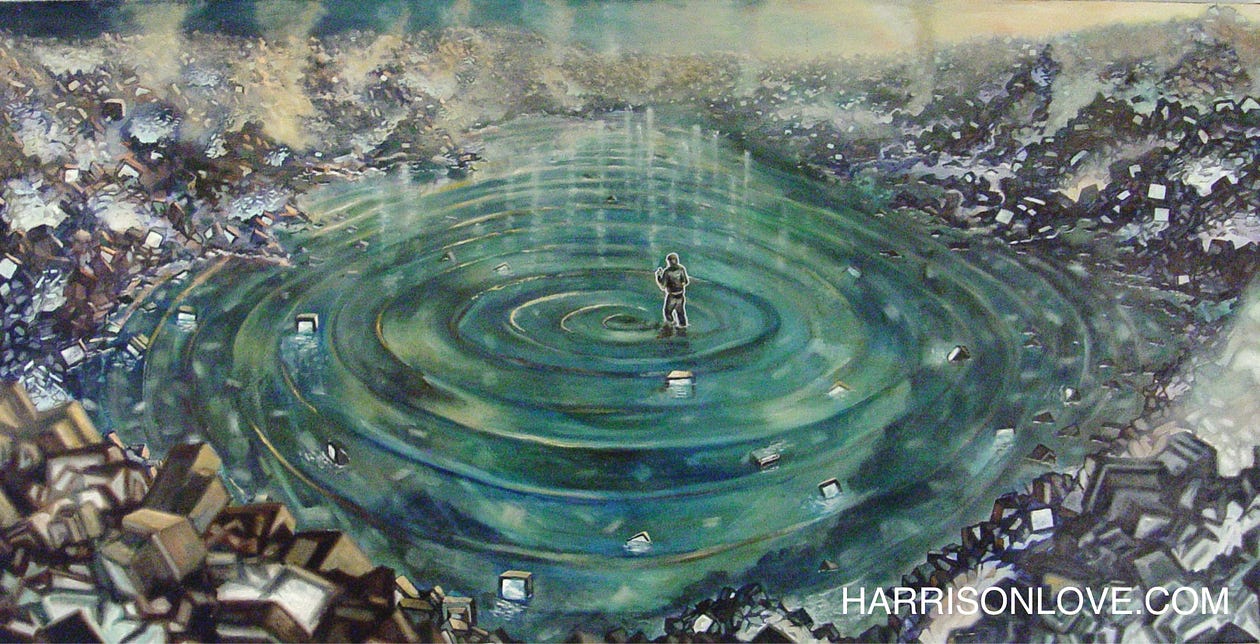
When I think of this gap between ancient human perception and radical innovation as a painter I think of the Cubists: they shattered form into fractured planes, multiple simultaneous views, only to re-anchor the viewer with still lifes and landscapes warped in familiar ways. That subtle tether let eyes and minds adjust instead of recoiling.
Like the Cubists, our brains resist being untethered. They want something recognizable, some launchpad , before they’ll leap into abstraction.

Innovation Requires a Launchpad
“The task of the modern artist is not to make the strange familiar, but to make the familiar strange.” — Victor Shklovsky
Humans rarely leap into the unknown without a recognizable step. Like Cubists offering a fractured still life instead of pure abstraction, innovators need to provide the audience with a doorway into the unfamiliar.
We require a foothold, something recognizable, before we’ll trust ourselves to take the next step. Innovation without a tether risks being dismissed as nonsense, not brilliance.
This is why the Cubists are such a telling example. Picasso and Braque weren’t naïve about their audience; they knew that diving headfirst into pure abstraction would leave viewers stranded. Instead, they deconstructed the recognizable, guitars, bottles, portraits, into geometric shards. The subject remained faintly visible, just enough for the mind to bridge the gap. That bridge was the real art: not the final image, but the carefully staged invitation to cross into an entirely new way of seeing.
This pattern repeats itself across history. Stravinsky’s Rite of Spring scandalized Paris with its dissonance, but it was still built on the scaffolding of ballet, an art form the audience understood. Punk rock still borrowed the verse-chorus spine of pop. Even the iPhone, heralded as a revolution, succeeded because it retained the familiar tropes of a phone while quietly teaching us it was, in fact, a handheld computer. Innovation smuggles itself in under the guise of familiarity.
This isn’t weakness, it is biomechanical. Our perceptual system clings to pattern-recognition; we seek continuity even when confronted with rupture. Neurologists argue that pattern completion is one of the brain’s fundamental operations, it would rather hallucinate continuity than confront chaos. In other words, we literally cannot leap into the new without a launchpad.
And this is why disruption in art, culture, and technology so often disguises itself. It doesn’t walk in wearing the mask of the future; it sneaks in wearing yesterday’s clothes.
“You must stand on the old roads before you build the new.” — Zora Neale Hurston

Familiar Masks of the Machine
So although it may seem a bit unfamiliar to some of my readers, the same principle that guided Picasso’s fractured still lifes applies eerily well to AI today: novelty rarely arrives naked. It wears a familiar mask.
Look at Refik Anadol’s data-driven installations, cathedrals of swirling color and machine-dreamt texture. They feel futuristic, but they succeed because they echo Impressionist brushwork, Color Field painting, even Rothko’s meditative voids. The audience stands in awe, not because they are seeing something incomprehensible, but because they are seeing something recognizably beautiful transposed through alien means. The tether holds.
Or take AI-generated music. When an anonymous creator released “Heart on My Sleeve,” an AI-generated track featuring the cloned voices of Drake and The Weeknd, it went viral precisely because it sounded like them. People didn’t marvel at the technology, they marveled at the familiarity. The song worked because it played the launchpad: the comfort of a beloved voice delivering something almost but not quite new.
“Those who do not want to imitate anything, produce nothing.” — Salvador Dalí
Even generative art tools like Midjourney or DALL·E rely on this tether. Ask them for something abstract, and they often stumble into incoherence. But ask for “a Baroque cathedral in neon” or “a Renaissance portrait painted by Basquiat,” and suddenly they produce work that feels legible, even thrilling. Again, the familiar is the delivery system for the shock of the new.
Many of the most successful AI creations so far are not alien at all, they are remixes, pastiches, extensions of what we already know. The audience doesn’t want to be dropped into uncharted territory without a map. They want the machine to hand them a rephrased version of the familiar, so they can recognize themselves in it.
This raises the question: if AI always feeds us new wine in old bottles, what happens when the machine no longer bothers with the bottles at all?

Remixing the Future
What we call “new” is often a remix — new genres, tastes, and technologies grow out of half-baked or forgotten ideas. Creativity rarely emerges ex nihilo (out of nothing); it mutates from what came before.
Much of creativity doesn’t emerge from a vacuum, it is built on what came before. Research in innovation studies has long debunked the myth of the lone genius. Creative breakthroughs are rarely “Eureka” moments; they’re recombinations of existing building blocks . A study of 200,000+ 3D models on Thingiverse showed that almost every “new” design is a remix, an iterative mutation of prior ideas, shared and adapted on platforms where the community grows the concept collaboratively .
Lawrence Lessig’s remix culture is more than a meme, it is a lesson in creative fluency. From medieval cento poetry to Persian radif improvisation, from hip-hop sampling to fan-fiction, artists have always worked by reassembling fragments of culture to weave new narratives. Digital tools have merely stripped away barriers, allowing anyone with internet access to join in the creative relay.
Innovation scholars Paul Romer and Brian Arthur argue that sustainable economic growth stems not from raw invention, but from recombining existing ideas into compositions that are progressively more valuable . So-called novel technologies from the iPhone to memes to Instagram filters are hardly original; they’re modular mashups of earlier forms, quietly re-labeled as “genius.”
But remixing comes with its own dilemmas. A large-scale study of the Scratch community (where kids share and remix animations) found that collaborative remixes often score lower in originality even as they multiply in generative output, what the researchers called the trade-off between novelty and remixability .
So creativity becomes a balancing act, enough familiarity to spark connection, enough novelty to feel like a step forward. In the design world this is framed by ambidextrous innovation models, organizations that can exploit existing strengths while exploring new territory, without pitching chaos or stagnation.
In cultural theory, this dynamic circulates through what Henry Jenkins called “convergence culture.” Where meaning is no longer dictated by top-down creators, but co-constructed by communities remixing and reinterpreting media across platforms. Fanship becomes authorship; audience becomes co-producer .
Thus, remixing isn’t derivative laziness , it has become the core engine of creativity in our era. Our future avant-garde won’t emerge from silence but from our collective creative sediment, from images, sounds, stories, software, recipes; layered, repurposed, and reimagined in infinite permutations.

Technology Moves Faster Than We Do
“The tools we build are always faster than the hands that wield them.” — Octavia E. Butler
Unlike humans, AI doesn’t need the same launchpads. It can synthesize and generate autonomously. Soon it won’t require prompts or guidance, it will spin out creation endlessly, extrapolating from the collective archive we’ve already given it.
For the first time in human history, the creative act is no longer bottlenecked by biology. Until now, all art, whether cave paintings, symphonies, or TikTok edits, has been tethered to the slow cadence of human cognition and motor skill. But AI, unburdened by our Stone Age circuitry, creates at machine-speed. It doesn’t need sleep, food, or a muse. It doesn’t wait for the “Eureka” moment in the shower; it just recombines, iterates, and outputs endlessly.
This is a paradigm shift. Our brains, tuned to recognize and build from patterns, can only hold so many variables at once. AI, however, can juggle billions. This isn’t intelligence as we know it, but it is production without pause and thus the tempo of creation has changed forever.
Already we see this acceleration in microcosm. In visual art, Midjourney and Stable Diffusion can generate thousands of variations on a prompt in seconds, what might take a painter a decade of canvases. In music, AI models trained on catalogs of artists like Drake or Nirvana can spin out endless “new” songs in familiar voices, blurring the line between homage and forgery. In literature, language models draft novels, essays, and poetry at a scale that could fill libraries overnight. The bottleneck is no longer the act of making, it is the act of deciding what matters.
For humans, this changes the nature of participation in the creative act. If creation is infinite and frictionless, then the scarcity shifts elsewhere. Scarcity is no longer in the making, but in the meaning. Which images are worth keeping? Which songs are worth listening to more than once? Which words actually add to the human story, rather than just swirling the same linguistic sediment?
This suggests a profound reorientation: the value of human creativity lies not in competing with the machine’s pace, but in slowing it down. We become filters, curators, editors ; people who decide what deserves attention. Expertise, taste, and discernment, once seen as secondary to production, may now become the main creative act. The painter is not just a maker of canvases but a thinker of what to make, why, and when. The musician is not just a writer of songs but a sculptor of experiences in an infinite ocean of noise.
And yet, there’s another dimension worth noting: the embodied, imperfect, deeply human side of creation. Neuroscience tells us that much of creativity springs from the default mode network, the wandering state of mind when we daydream, get bored, or let the mind drift. This looseness, our inability to be perpetually productive , has always been part of what makes human creativity resonant. We are bound by failure, delay, doubt, and lived experience. These inefficiencies are not faults; they are often the necessary stillness before great of Art happens.
If AI creates in straight lines, humans create in detours. Our wrong turns, our cultural scars, our personal histories, all those hesitations and mistakes become the material of something AI cannot truly replicate: a point of view shaped by a body moving through time.
Thus, the relevant point for us, as technology accelerates, is not to outpace the machine but to insist on the irreplaceable depth of human presence in creation. AI can make a thousand paintings, but it cannot spend a childhood wandering Brussels, or fail at love, or wrestle with dyslexia, or live through political upheaval. These are not prompts; they are lived conditions. They form the launchpads only humans can stand upon.
As machines sprint, we must learn to walk differently. Not faster, but with more delight in our steps.
“The machine does not isolate man from the great problems of nature but plunges him more deeply into them.” — Antoine de Saint-Exupéry
The Shifting Role of Human Input
If machines can generate infinite outputs, what matters about our input? The future value of human creativity lies not in making more things, but in recognizing what matters.
“Where is the wisdom we have lost in knowledge? Where is the knowledge we have lost in information?” — T.S. Eliot
Humans have always been responsible for the leaps of genre, the audacious pivots that redirect culture. AI, for all its brilliance in recombining, does not originate these seismic shifts; it amplifies, extends, and translates them.
Consider jazz. Its emergence wasn’t just a new “style” of music; it was a genre shift, a rearrangement of cultural DNA born of lived histories, migration, oppression, improvisation. Or hip-hop, which didn’t merely remix funk and soul but redefined what counted as music at all. These ruptures, the breaking open of entirely new categories, require not only creativity but a situated human experience, a willingness to disrupt the rules of the game.
AI excels within a framework continuity. Once a genre is cracked open, AI can pour itself through the fissure, producing bridges that help audiences follow. So returning to my earlier example in cubism, the audience needed still lifes as a tether. In the near future, it may be AI that provides those tethers: generating familiar “translation works” that ease the leap from the old form to the new. The human artist can/will/and should break the boundary; the machine will lay down the bridges so others can cross.
This collaboration reframes the creative act. Humans may become the provocateurs — the ones who dare to redraw the map of culture, while AI becomes the cartographer who fills in the roads and side streets so the rest of us don’t get lost. The role of human input, then, is not to keep pace with the machine’s endless production, but to decide where the break happens. To ask: what is the next genre, the next way of seeing, the next redefinition of art, story, or sound?
The Art of Discernment
Our expertise, our ability to sense quality, to distinguish brilliance from noise, becomes essential. Creativity’s future role for humans may be less about producing and more about curating, judging, and refining.
“Tell me to what you pay attention and I will tell you who you are.” — José Ortega y Gasset
If creativity becomes infinite, discernment becomes priceless. In a world where machines can output limitless novels, symphonies, paintings, and films, the true scarcity is not in production but in recognition. What matters is not that something can be made, but that it deserves to exist.
This is where human creativity shifts from making to meaning-making. Taste, intuition, judgment, these become the central acts. To know quality when you encounter it is not trivial; it is an evolved instinct sharpened by history, culture, and failure. AI can echo the surface of our styles, but it cannot feel the weight of a tradition, the ache of an era, or the silent lineage of mistakes that led to a breakthrough.
Artists have always been more than producers. They have been filters, distillers of the infinite into the meaningful. The medieval monk illuminating a manuscript wasn’t just decorating pages; he was preserving sacredness in a world of chaos. A jazz musician choosing which notes not to play carried as much genius as the improvisation itself. Today, the act of saying no to the infinite, of knowing what not to make, what not to keep is becoming a creative superpower.
AI, for all its generative might, lacks that human hesitation. It doesn’t wrestle with mortality, or memory, or the unshakable sense that some moments matter more than others. It cannot be haunted by failure or humbled by history. But we can. And that haunting, our entanglement with time and consequence is our advantage.
Looking ahead, I imagine a partnership where the human role is twofold: to rupture genres, inventing new categories, new ways of seeing, and to act as the custodian of discernment, sifting meaning from noise. AI will fill in the bridges, extend the reach, and remix the possibilities, but we will remain the ones who declare: this is art; this is worth crossing over for.
Perhaps the last great human art will not be painting or writing or composing, but the art of choosing. Choosing which innovations matter. Choosing which stories deserve to be told. Choosing, in an age of infinite creation, what to treasure as rare.
And maybe that’s what keeps us human. Not speed. Not scale. But the slow, difficult, stubborn instinct to make meaning out of abundance.
“The future belongs to those who can imagine it.” — Hannah Arendt
Creation has always been more than the act of making. It is a ritual of attention, a decision to lift one fragment of possibility out of the infinite and grant it form. In this new age, where machines will dream endlessly on our behalf, our role may be pared down to something ancient and sacred: to witness, to weigh, to choose.
What is rare now is not production but presence. To stand before an image, a gesture, a story and to recognize in it the trembling thread that connects us to one another, to history, to the ineffable currents of meaning, is the last human task. AI can supply abundance, but it cannot confer significance. That burden, and that gift, remain ours.
Perhaps then, the art of the future is not the flood of invention but the stillness of discernment. The willingness to pause, to say: This one, here, matters.

Author:
Harrison Love is Artist and Author of “The Hidden Way,” an award winning illustrated novel inspired by first hand interviews about Amazonian Myths and Folklore. He is also the Founder of the Permaculture Art Gallery STOA. More information about his Art and Writing can be found on www.harrisonlove.com
Bibliography:
• Wilson, Edward O. Consilience: The Unity of Knowledge. Vintage, 1999.
• Shklovsky, Viktor. “Art as Technique.” In Russian Formalist Criticism: Four Essays, translated by Lee T. Lemon and Marion J. Reis, University of Nebraska Press, 1965.
• Hurston, Zora Neale. Dust Tracks on a Road. Harper Perennial, 1942.
• Dalí, Salvador. Quoted in: Descharnes, Robert, and Gilles Néret. Dali: The Paintings. Taschen, 2007.
• Saint-Exupéry, Antoine de. Wind, Sand and Stars. Reynal & Hitchcock, 1939.
• Butler, Octavia E. Bloodchild and Other Stories. Seven Stories Press, 1995.
(The phrasing about tools being faster than the hands is paraphrased from her essays on technology and survival; Butler frequently stresses that tools outpace human adaptation.)
• Eliot, T.S. “The Rock.” In Collected Poems 1909 — 1962. Harcourt, Brace & World, 1963.
• Ortega y Gasset, José. What Is Philosophy? W.W. Norton, 1960.
• Arendt, Hannah. The Human Condition. University of Chicago Press, 1958.
(The line “The future belongs to those who can imagine it” is a condensation of Arendt’s reflections on natality, imagination, and futurity.)


Comments
Post a Comment