Artful Theater
Artful Theater

“Give a man a mask and he will tell you the truth.” — Oscar Wilde
From the very beginning of my practice, I have carried with me a facility for rendering the world both as it appears and as it might be imagined. Realism, surrealism, and abstraction have each found a home in my hand, not as separate disciplines but as intertwined languages through which I speak. I have always been able to move fluidly across these modes, shaping forms that honor the physical world while reaching beyond it. Having worked in a wide array of mediums, I discovered that the true measure of my versatility was not bound to materials or techniques, it was bound instead to the vantage point from which I created.
It was this recognition that led me to understand that identity itself became the only real boundary to my practice. If the canvas is infinite, then authorship is the frame that shapes how the work is perceived.
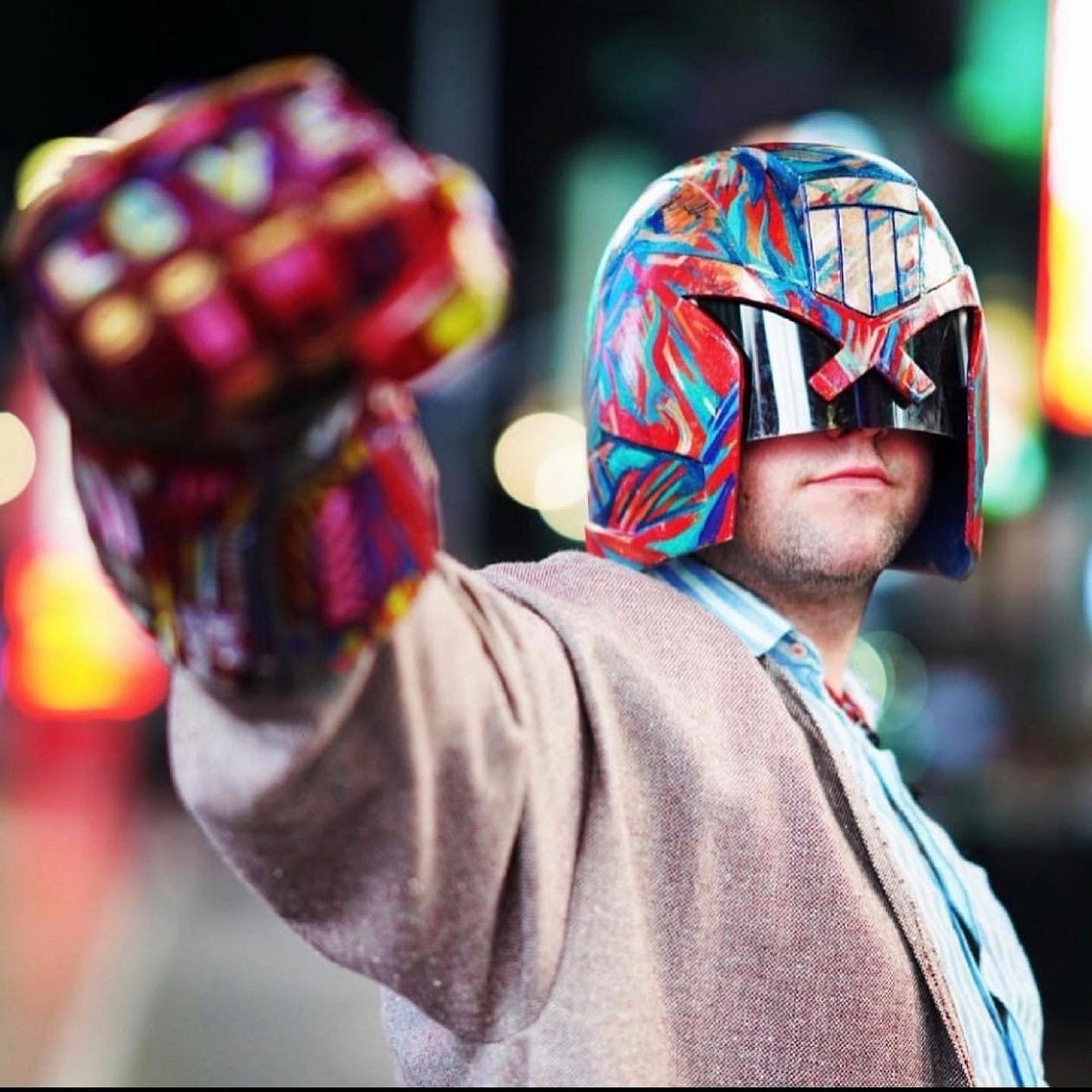
So in order to break free from that singular lens, it became necessary for me to branch outward into pseudonyms, to cultivate multiple artistic identities through which my work might unfold. In doing so, I liberated my imagination from the confines of one narrative, allowing each name, each mask, to carry its own sensibility, style, and mythos.
Here is a short video which rapidly Timelapse’s my artwork over time:
Social Media is a bizarre stage where Artists not only exhibited but are expected to perform, where every image is followed by the demand for commentary, interaction, and proof of presence. For the artist, this can be both a gift and a trap: the perception of a limitless audience on one hand, and on the other, a constant erosion of the quiet, private space in which true creation takes root.
I am of the generation of initial users to SM and I quickly decided to engage in a social experiment with my work. My solution was to multiply my ego across multiple profiles, each carrying its own voice, its own identity. I found that by multiplying myself, I freed from the burden of representing the entirety of who the audience thought I should be. I needed to preserve the integrity of creation in a space that so often demands performance over process.
Inspired by graffiti artists and their methods of maintaining multiple pen-names I have always been attracted to the concept of an alter ego. And so as I evolved as an artist I found a kindred spirit in the worlds of street artists like Rammellzee and the rapper MF Doom, artists who transformed identity itself into a creative medium. Rammellzee approached letters as warriors and symbols as armor, crafting entire mythologies around his alter egos and their battles — turning language, graffiti, and persona into performance. MF Doom took a different but equally powerful approach, donning a mask to blur the line between the artist and the art, creating a space where the work could exist independently from the man behind it.
I realized that identity could be as fluid and expressive as brushstrokes or spray paint. I began to experiment with creating alternate selves in my own work, not just as a playful disguise but as a strategy to explore different perspectives, styles, and emotional registers.
One of my earliest and most ambitious experiments in multiplicity was Vandal Magazine. At its height, it existed not as one voice but as six. Each identity had its own style of writing, its own visual sensibility, even its own email address and social media presence.
In the beginning, this structure was exhilarating. It allowed me to write in radically different tones without compromise, to test ideas that would have clashed had they shared the same byline. Some artistic styles were sharp and realistic, others lyrical and abstract. It was as though I had built an art movement comprised of fragments of my own imagination.
But what begins as play can quickly become obligation. Each identity required attention, updates, and upkeep. The illusion demanded constant tending, and in time, the labor of sustaining six separate selves became unsustainable. The collective slowly dissolved, not with regret, but with the recognition that the experiment had revealed its limits.

Vandal Magazine showed me the power and the peril of artistic division. It taught me that while alternate identities can liberate the artist, too many of them can smother.
To multiply oneself is to step into the ancient tradition of masks. The Greeks wore them in the theater; shamans donned them in ritual; poets adopted them in pseudonyms. I followed this same instinct, though my stage was digital. Each profile became a persona through which I could express a different dialect of my imagination.
This experiment offered freedom from the narrowing weight of a singular “brand,” a word I have always found hostile to the deeper pulse of art. Under these different names, I could move unencumbered, take risks, abandon restraint, and enter new territories without dragging an audience’s expectations behind me. It was a form of protection from the subtle compromises that come when one is always seen, always expected to be the same.
“Anonymity is a shield from the tyranny of the majority.” — Banksy

The metrics of my experiment were undeniable. On TikTok, one of my performative artworks reached over two million views. On Instagram, posts saw growth of over 30,000%. From a numerical perspective, the experiment was an overwhelming success.


Yet the triumph felt hollow. The audiences who engaged most were rarely those who visited galleries, attended shows, or engaged with my broader body of work in meaningful ways. Instead, they were drawn to the spectacle itself. Viewers maintained obsessive, parasocial relationships with the pseudonyms.
This realization exposed the subtle dangers of catering to metrics and attention, and it reshaped the way I produce and present my work. I now prioritize creation and community over performance, focusing on contexts where engagement is grounded in curiosity, appreciation, and genuine dialogue. For any artist considering similar paths, I would caution: the allure of viral numbers can come at the expense of integrity, and the audience it attracts may not be the one your work truly deserves.
There were undeniable rewards in giving each voice its own home. I found a clarity that would have been muddled if all were forced to live under one roof. This multiplication granted me freedom from the invisible chains of expectation. A single identity, especially online, quickly becomes a cage. It develops a rhythm of recognition that audiences come to expect, and the artist, in turn, begins to bend toward what is most easily received. I managed to escape that gravitational pull. No one profile carried the burden of satisfying the whole of my audience, and so I could move without restraint, testing the edges of my imagination without fear of diluting a singular image of “who I am.”
There was also a kind of safety in experimentation. To take risks under one name is to expose the entirety of oneself to judgment; to take them under another is to grant oneself the privacy of failure. And failure, in truth, is one of the most essential ingredients to growth.
Social media is not optimized for creatives, it demands presence, interaction, a continual proof that one is alive and producing. In this way, the artist is coaxed into becoming a performer. I felt this most sharply when creating for multiple accounts at once; instead of painting in silence, I was measuring the timing of posts, watching for the pulse of engagement, and shaping the work to meet the demands of the stage.

Recently The National Gallery in London, with its vast reach and authority, recently outlined clear expectations for the social media presence it would accept from its contributing creators. The guidance included precise metrics:
50,000 followers on YouTube
100,000 followers on Instagram
50,000 to 1,000,000 likes on TikTok
Creators are expected to demonstrate sustained engagement, regular posting, and a certain reach in order to be considered for recognition or promotion.
These statistics were striking. They quantified a reality I had long felt but not seen so clearly: the performative aspect of social media is increasingly dictating access to professional opportunities. Their requirements underscored the practical pressures that social platforms place on creators, and the ways in which visibility, rather than artistry, is often measured.
“I am in revolt against the system that defines me.” — Claude Cahun
The ethos of the artist has been interrupted. Social media, with its relentless metrics and algorithmic hierarchies, has redefined the field of artistic visibility. Artists are pitted against one another not for insight, innovation, or mastery, but for fleeting units of attention: views, likes, shares. Algorithms dictate whose work rises and whose falls, subtly urging us toward homogeny. What succeeds in this environment tends to be replicated, remixed, or mimicked, until originality itself risks being subsumed by a culture of repetition. The artist, once guided by the compass of personal vision, is now nudged toward producing in ways that appeal to the machinery of metrics rather than the mystery of creation.
This shift has fostered a new kind of competition, one alien to the history of art. Never before did we measure our work against one another in such numerical, public, and performative terms. Our only contest was always internal , against the boundaries of our imagination, the discipline of the craft, the stubborn resistance of the medium. Now, however, the system encourages us to compete for visibility in a landscape governed by forces indifferent to art’s true purpose. In such a climate, the danger is not simply that artists will imitate one another, but that they will slowly forget the deeper call to expand themselves and the medium itself.
From my own personal experiment, I carry both gratitude and weariness. Gratitude for the freedom it gave me, the chance to explore unbound by a single name. Weariness for the weight of sustaining so many selves, each clamoring for attention in a space that never sleeps.

Yesterday, I had 7 instagrams (the maximum). I had 4 Meta Pages and two profiles as well as two TikToks. But now I have come to see that the very stage that offers visibility also extracts a cost, and in my case, it has too often blurred the quiet integrity of creation.
And so, I choose to return to one point of focus. Not because the experiment failed, but because it proved sufficiently to me to not be worth my energy. What I seek now is to create not for the stage, but for the work itself, to let the masks fall away and to speak, once more, in a single voice. That voice now is telling you the truth. Artists, please don’t play the game of Social Media. Don’t do things for likes or for attention and don’t buy followers just to serve some vane pursuit of appearing influential. In time you may look back as I have and wonder why I didn’t use all that energy to make more art, to write more, to create even more or a substantial body of work.
If you are an artist or creator, ask yourself these questions and if you will please leave a comment with your answer:
Is it truly in the artist’s interest to perform, to promote oneself as if one were an influencer navigating the currents of social media? The demands of constant visibility, of shaping each action to meet audience expectations, risk fracturing the very integrity that gives art its gravitas.
When we adopt a performative mask, even temporarily, are we not shifting attention away from the work itself and toward the spectacle of our persona? To cater to what audiences have already recognized or categorized may feel strategic, but it comes at a cost. The quiet, unhurried labor of creation, the delicate, often unseen work that shapes character and style, can be obscured, compromised, or even lost.
If the goal is to cultivate an authentic voice, then every forced gesture, every post engineered for attention, risks diluting it. How does one balance visibility with integrity, engagement with authenticity, without losing the heart of what it means to create?

— — —

Harrison Love is Artist and Author of “The Hidden Way,” an award winning illustrated novel inspired by first hand interviews about Amazonian Myths and Folklore. He is also the Founder of the Permaculture Art Gallery STOA. More information about his Art and Writing can be found on www.harrisonlove.com


Comments
Post a Comment